Project Case Study
AI Assisted Breast Tumor Classification
A dual-stream transfer-learning ensemble using complementary CNN backbones to classify mammogram images into multiclass BI-RADS categories. The project includes careful preprocessing, augmentation, and uncertainty-aware prediction aggregation, with model inspection tools and visualization exposed through an interactive Streamlit dashboard for rapid clinical triage and experimentation.
More on GitHub: sajjadul-islam-somon/Mammogram_App
Overview
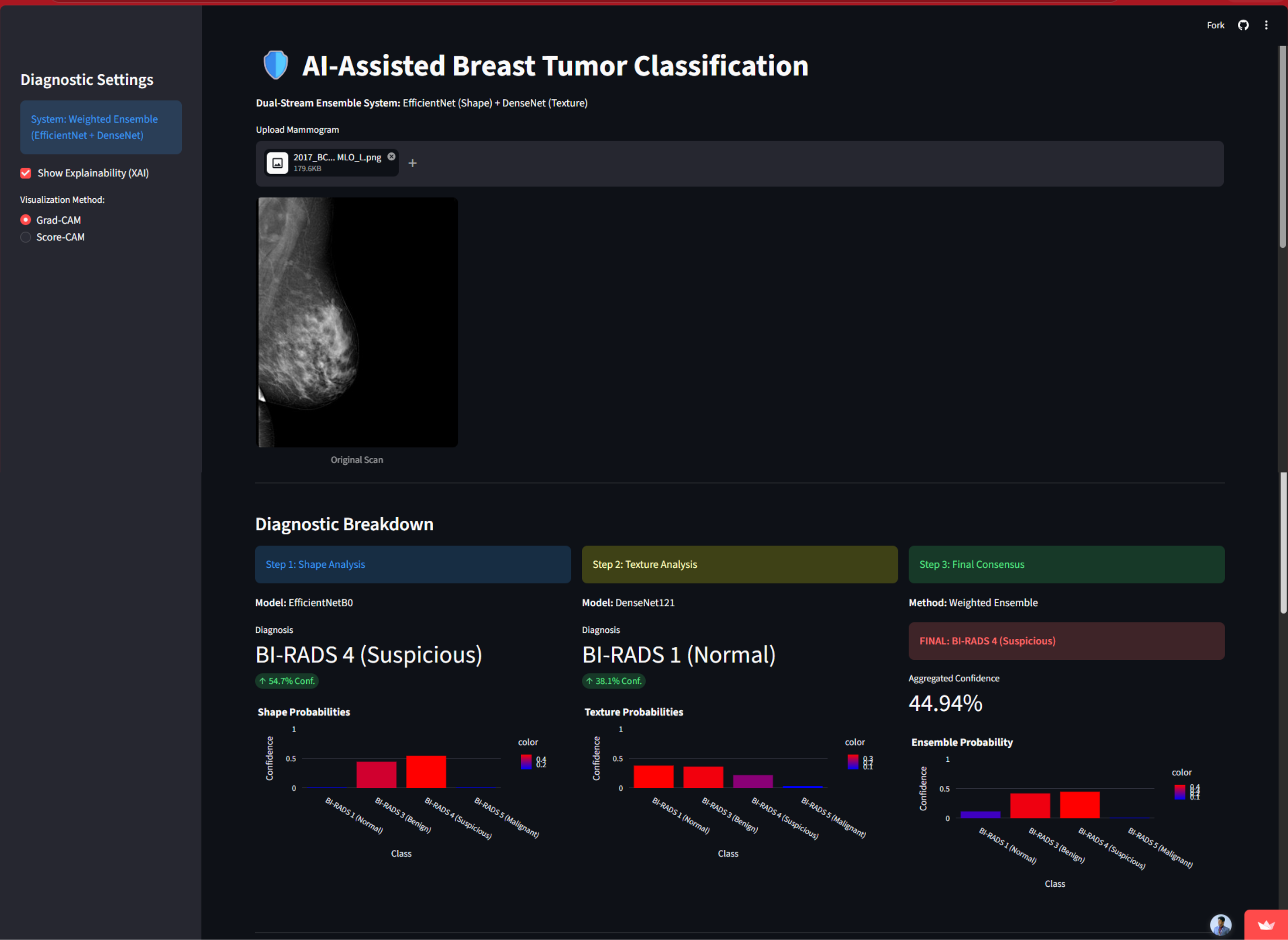
Mammogram App is an interactive Streamlit application for mammogram analysis. It uses a weighted ensemble of two deep-learning models, EfficientNet for shape-aware classification and DenseNet for texture-aware classification, to produce a final BI-RADS diagnosis from an uploaded scan.
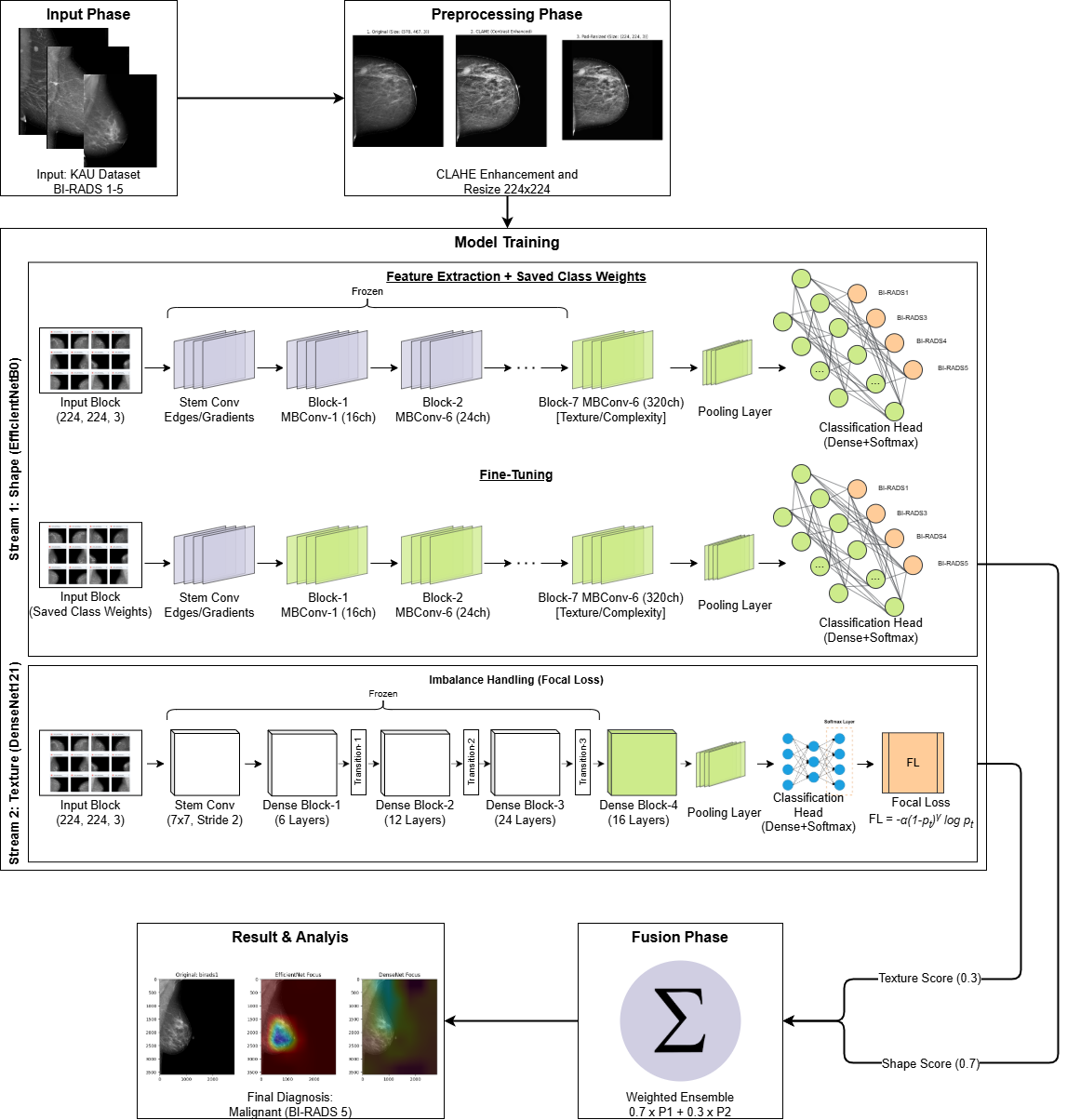
The app surfaces the workflow clearly, so the preprocessing, model inference, and explanation layers are easy to follow.
- Preprocessing flow: ROI cropping, CLAHE, RGB conversion, and padded resizing before inference.
- Prediction confidence: model-wise charts and final ensemble output for easier comparison.
- Explainability overlays: Grad-CAM and Score-CAM highlight image regions that influenced the decision.
Challenges
The main challenge was preparing mammogram images in a way that preserves anatomical detail while still standardizing inputs for two different models. The app also needed to keep predictions understandable through confidence charts and optional explainability overlays without slowing down the core inference flow.
Solutions
The app preprocesses each scan by cropping the breast region of interest, applying CLAHE for contrast enhancement, converting back to RGB, and resizing with padding to 224 × 224. It then runs both models, combines their predictions with a weighted ensemble, and can generate Grad-CAM or Score-CAM heatmaps for visual explanation. Model loading is cached to keep the Streamlit experience responsive.
Impact
The result is a compact decision-support workflow that can classify scans into BI-RADS 1, 3, 4, and 5, display confidence charts for both models and the final ensemble, and optionally overlay heatmaps to show what influenced the prediction. That makes the pipeline useful for clinical triage, research demonstrations, and future extension into batch inference or reporting.